


We teach our middle-grade students to begin their essays with a hook, a sentence designed to get their reader’s interest. But just what kinds of sentences qualify as hooks? Questions, for sure; in fact, a question seems to be the go-to essay opener for this age range!
Beyond questions, however, many kids in upper elementary and middle school would be hard-pressed to come up with interesting sentence types with which to open an essay. Some might try adding in a few adjectives to fancy up their basic “I’m going to tell you about . . ,” but otherwise any number of kids just haven’t yet learned what is really expected of them in this situation.
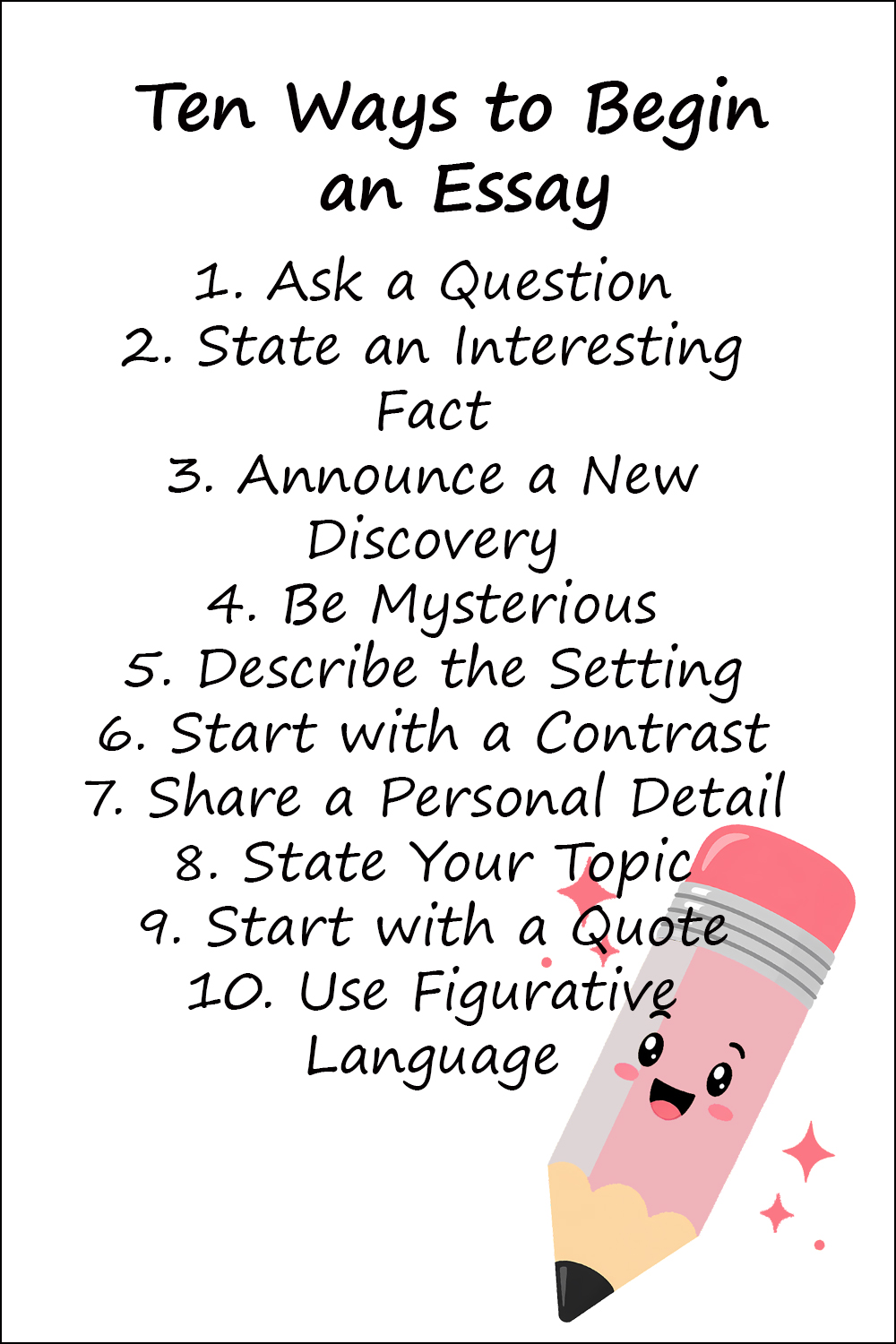
Starting with the popular “Ask a question,” here are ten possible ways to begin an essay with examples and a few ideas of what type of essay each one might be used for.
1. Ask a Question
Example: Would you like to know how I earned enough money to buy a great new bike over the summer vacation?
Use for: As our fast-thinking middle graders have already discovered, this one works for just about any type of essay!
2. State an Interesting Fact
Example: An owl can turn its head around an amazing 270 degrees – that’s 3/4 of the way around!
Use for: content area essays, such as history or science topics, or other informational topics
3. Announce a New Discovery
Example: I’ve discovered a quicker method for packing lunches for my brothers and sisters and me.
Use for: essays about discoveries in science, archaeology, etc., or for how-to essays, in which the “discovery” is the writer’s method for completing the task
4. Be Mysterious
Example: When I brought it into my kitchen, the pumpkin was ordinary – small and orange, but now it was huge, overtaking the whole kitchen counter and glowing a bright, neon hue!
Use for: stories, strange science phenomena
5. Describe the Setting
Example: Snow was piling in drifts up to the windowsills, as the icicles hanging from the roof grew longer and longer.
Use for: biographies, autobiographies, stories
6. Start with a Contrast
Example: The first computers were so big that one computer could fill a whole room, but today’s computers are so small that you can wear one hidden in the frame of your glasses.
Use for: descriptive, informational, and persuasive essays
7. Share a Personal Detail
Example: In July before sixth grade, I broke my leg and spent the entire summer on crutches.
Use for: biography and personal essays
8. State Your Topic
Example: Leafcutter ants use their jaws like a saw to cut leaves.
Use for: informational or persuasive essays
9. Start with a Quote
Example: Supreme Court Justice Ruth Bader Ginsburg said, “Real change, enduring change, happens one step at a time.”
Use for: history, current events, biographies
10. Use Figurative Language
Example: Knowing how I avoided housework, the broom slumped comfortably in the corner, enjoying its free time.
Use for: Like the popular question opener, this one can also be used for most any type of essay.
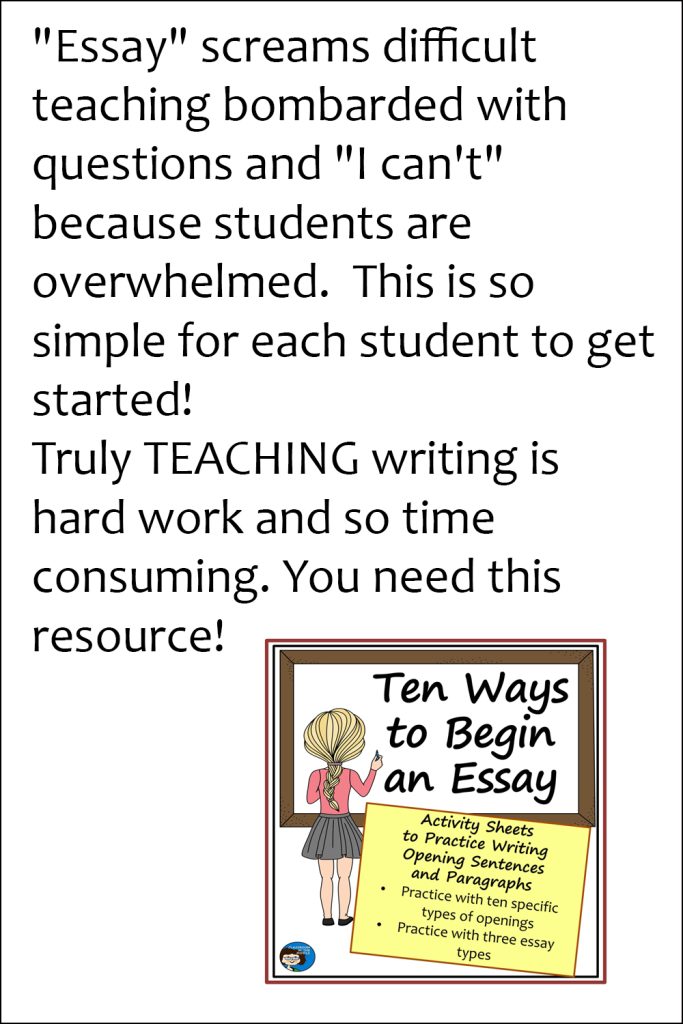
My “Ten Ways to Begin an Essay” resource is a painless way for kids to practice each of the ten ways without having to think about writing whole essays! This is one of the worksheets.
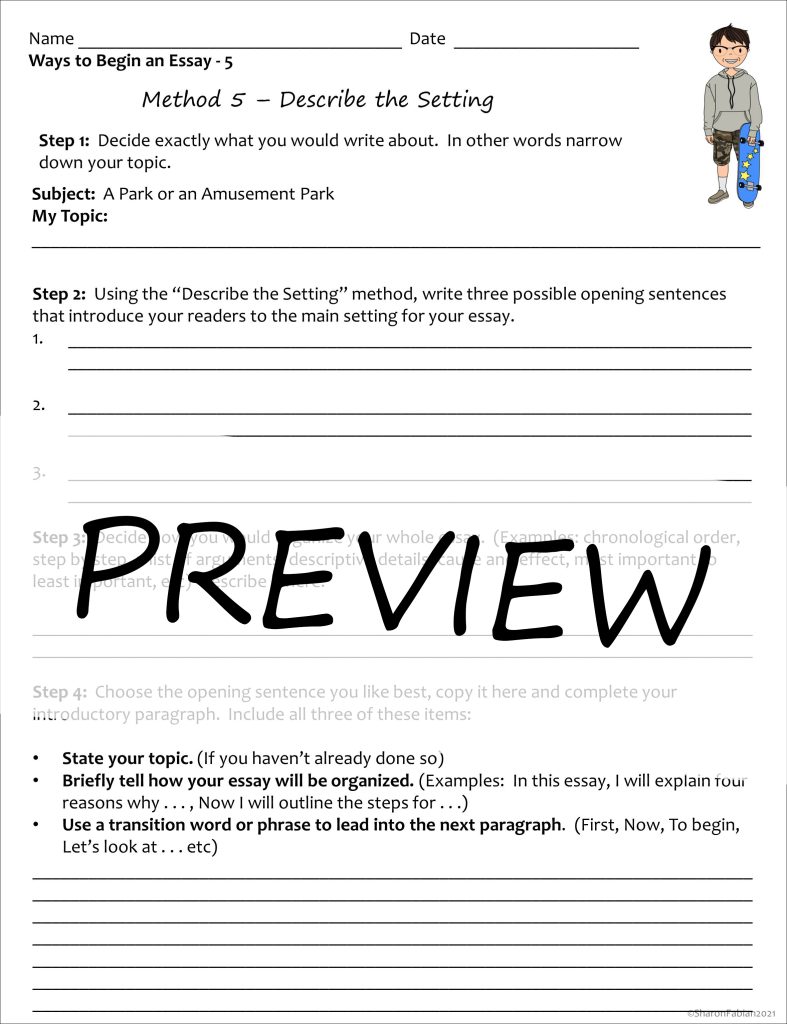
The different types of opening sentences are pretty much self-explanatory. For a difficult topic, it really doesn’t require much explanation; the kids mainly need to get in a little practice!
One teacher let me know that this resource was just what her class needed. She also noted that teaching essay-writing was a difficult task for teachers. She said, “This is so simple for each student to get started! . . . You need this resource!”